

Is There Evidence of God's Existence? Part 1
Can this reality impact your life?

The question of God’s existence must be answered without consideration of the potential social impact of the answer. Unless you are willing to answer this question in your own mind without thinking of the personal implications, your baser instincts will kick in concerning personal desires to hold onto a lifestyle or need to address the definition of morality.
The main difference between atheism and agnosticism is that atheists do not believe in a God, while agnostics believe it is impossible to know if a God exists. Both of these views come down to personal choice. Atheists refuse to believe in God, and agnostics think it’s impossible to know for sure, and neither position is a good argument supporting the absence of God in light of the evidence pointing to the appearance of design in our universe.
In our past article, we ended on the intelligent design theory and its implications on the question of our origins. Knowing the answer to this question of God’s existence can be life-changing. Unlike atheism and agnosticism, did you know that there are five good arguments that support the existence of God? They are known as the cosmological argument, the teleological argument, the moral argument, the historicity of the resurrection of Jesus Christ, and the sense for the presence of God. Let’s explore each of these in greater detail.
The first three are anthropic arguments. These relate to us and our existence on earth. Evidence supporting the thesis that God exists can be observed in these three areas:
Cosmological,
Teleological, and
Moral arguments.
The Cosmological Argument
The evidence for the beginning of the universe points back to an event commonly referred to as the Big Bang Theory. Theist say the banger (cause) was God that created (effect) the universe. Intelligent Design theorists point to a mind (cause) that decided to create (effect) the universe. Naturalists claim that a quantum realm (math) was the cause that created the universe, even though you need something already created to measure with quantum theories.
Atheist and scientists admit the universe had a beginning:
Dr. Stephen Hawking: "Almost everyone now believes that the universe, and time itself, had a beginning at the big bang."
Cause and effect. No cause, no effect. Agnostic scientists admit the universe had a beginning:
Dr. Alexander Vilenkin: "With the proof now in place, cosmologists can no longer hide behind the possibility of a past-eternal universe. There is now no escape, they have to face the problem of a cosmic beginning."
Concerning the Big Bang, there’s another reason why “scientists and many physicists have been fighting a rearguard action against it for decades." As a recent editorial in New Scientist explained. That is, its alleged “theological overtones”. The New Scientist editorial put it this way: “If you have an instant of creation, don’t you need a creator?”[1]
In Lisa Grossman’s article titled/subtitled: “Death of the eternal cosmos—From the cosmic egg to the infinite multiverse, every model of the universe has a beginning.” The article relates how physicists such as Stephen Hawking, a devout atheist, “tend to shy away from cosmic genesis” in order to avoid “the thorny question," i.e., the need for a supernatural creator. They had relied upon models designed to dodge the origins problem, such as an eternally inflating or cyclic universe, which give the appearance of time continuing indefinitely in the past as well as the future.[2]
Grossman’s article points to the issue of how scientific evidence gets warped based upon the worldview of the scientist. Hawking was an Atheist, yet even when faced with the evidence of a creator or outside agent, he “relied on models designed to dodge the problem, which was the evidence of a creator or outside agent.
Scientists agree, there has to be an outside agent. The interpretation scientists publish concerning causality shaped by their worldview is all that is at issue. If the universe had a beginner, the evidence leaves us with the following 3 options:
Nothing created something out of nothing (Atheistic/Agnostic/Naturalist view), or
An intelligent agent created something out of nothing. (Atheistic/Agnostic/Naturalist view), or
God created something out of nothing (Theistic view).
Which view is more reasonable? If space, matter, and time had a beginning, and if the design of their properties is so complex that we are still trying to figure out how they were created, then 2 or 3 has to be true. Atheist philosopher Leibnitz posed this question: "If there is no God, then why is there something rather than nothing at all?"
The cause for our existence has to be spaceless, timeless, immaterial, and a powerful enough personal agent that chose to create. This agent possesses an intellect beyond our own to make a choice. Some scientists who uphold the Intelligent Design theory say that “this intelligence may or may not be God, and we don't know at this point if it’s the Judeo-Christian God.” Despite the uniqueness of a book that records hundreds of confirmed prophecies of future events written in it, it leaves an interesting clue in Genesis Chapter 1 verse 1 of the Judeo-Christian Bible: “In the beginning God created the heavens and the earth.”
Lawrence Krauss, who calls himself an anti-theist, is a theoretical physicist at Arizona State. He tried to explain how the universe could come out of nothing all by itself. His nothing is not nothing, but what he refers to as a quantum realm. Krauss contends that space, matter, and time can come into existence as long as you have space, matter, and time. That doesn’t explain how the universe can come from nothing. Space, matter, and time are created physical properties that have been designed by an intelligent designer agent.
Krauss celebrates that there is no God. Why does he say that? Perhaps he doesn't want there to be a God. Pasqual said that people invariably believe what they find attractive. Consequences for God:
With God, we have blessings on earth, a written moral code to follow, and an afterlife in heaven.
Without God, people get to do whatever they want here on earth with no spiritual or moral consequences, and then we are all worm food.
One of the biggest questions of mankind is why do we have a universe that had a beginning? Atheists believed in the past that the universe has always been in existence. Recent philosophical and scientific discoveries such as the “big bang”, and Einstein’s theories have shown that the universe had a beginning. What is so startling about the big bang theory is that what scientists would call causation, created the universe out of nothing, and now suddenly we have space, time, matter, and the controlling properties such as entropy and gravity. All matter, energy, space, and time itself came from nothing. Scientists don’t even know where energy came from. So, an Atheist believes that nothing created nothing. Does that make sense to you?
The cause of the universe had to be an uncaused, space less, timeless, immaterial, entity possessing enormous power and intelligence that brought everything into being. Cosmologists and theoretical physicists have concluded that the universe in fact had a beginning and is not infinite as one thought.
William Lane Craig[3] said in his debate with a prominent atheist that cause is personal because it’s beyond space and time, so it can’t be physical or material. The only thing that describes that are abstract objects like numbers or a personal mind. Abstract objects can’t cause anything, so you have to have a personal mind for causation to occur.
The founding fathers of science like Copernicus, Kepler, Galileo, and Newton, believed that the universe was the product of a mind. To these scientists, science was a theological quest to uncover the secrets of how God created the universe around us. To glimpse the mind of God if it were to see how the universe was put together. Copernicus believed that the universe was made for us (propter nos Latin) and that we were part of that plan.
So, the cause of the universe is an intelligent, transcendent mind. Thus, the cosmological argument gives us a personal creator, or God.
Teleological Argument
The teleological, also known as the argument from design or the intelligent design argument, is an argument for the existence of God or, more generally, for an intelligent creator, "based on perceived evidence of deliberate design in the natural or physical world". It is an argument in natural theology.
This argument demonstrates that the universe and nature have been designed based upon phenomena in terms of the purpose they serve rather than of the cause by which they arose. It suggests the existence of God by virtue of the universe as a whole acts like a machine. Machines require a designer.
The Universe
Scientists have discovered that the universe is fine tuned. There are certain truths about our universe that have been identified, that if they were any different, the universe could not exist or exist to the point to support life.
Dr. Stephen Hawking said: "If the expansion rate of the universe was different in a thousand, million, million a second after the big bang, the universe would have collapsed back onto itself or never developed galaxies."
You can't say that the expansion rate evolved to this rate. It had to be set at the inception of creation. The same being or agent that created space matter and time is the same one that set the expansion rate of the universe. The expansion rate is considered to be one of the initial conditions of the universe.
If the gravitational forces in the universe are also set to a specific rate. If it were altered more than 1 part in 1040 compared to the strong nuclear force, stars like our sun would not exist, and therefore neither would we. 1 part in 1040 power means 1 chance in 10 with 40 zeros after it.
There are only two reasons for that value to be there. It was either designed to be there or it was not. Could it happen by chance, or was it designed? Chance is not a cause. It's a word we use to describe possibilities. What appears to be the most likely answer?
Our Solar System
Our solar system is also tightly defined, which exhibits design:
Earth is the 3rd planet from the sun. 1 degree closer to the sun, we burn up. 1 degree farther from the sun and we would freeze.
Axial tilt of 23 1/2 degrees. Change that and we don’t exist.
Change earth's rotation around the sun to greater or less than 24 hours and we don’t exist.
The size of the moon and it's distance from earth—change that slightly and we don't exist either.
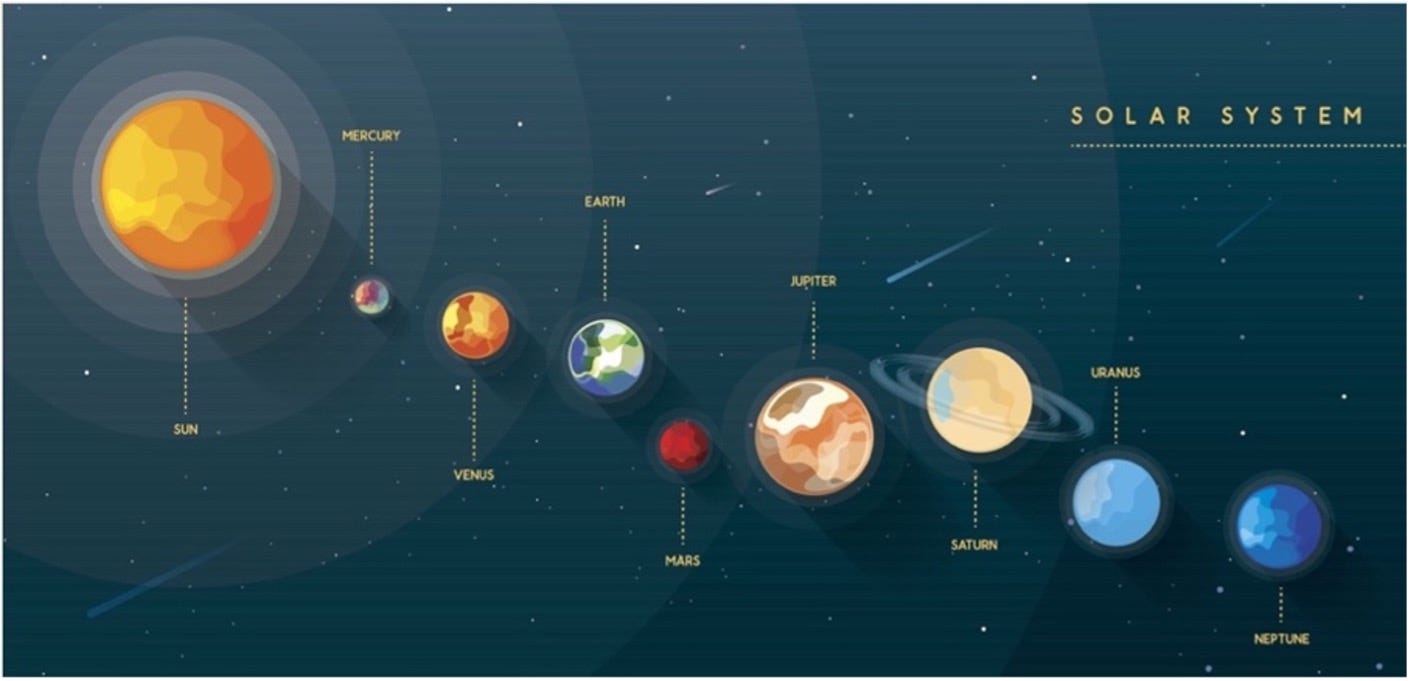
If Jupiter didn't exist in its current placement, we could not exist. Jupiter acts as a giant cosmic vacuum cleaner. It sucks up earth-sized meteors and comet fragments and draws them away from earth to itself rather than hitting us. If Jupiter didn't exist, neither would Earth. See all the spots on Jupiter? Those marks on Jupiter are earth planet-sized debris. Jupiter’s gravitational field pulled into itself, saving us from strikes on Earth.
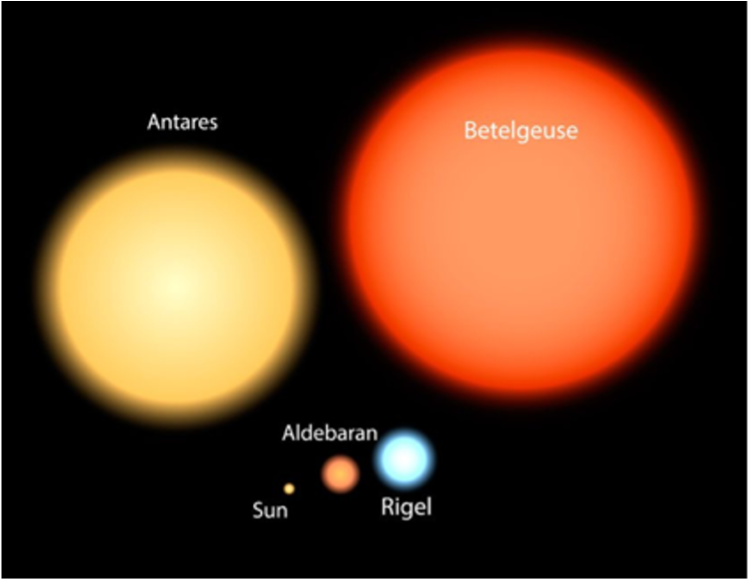
These are the suns just in our galaxy. Our sun is barely visible compared to Antares
and Betelgeuse. Earth and the rest of the planets revolving around our sun are too small to see. If the earth were the size of a golf ball, Betelgeuse would be 5 or 6 Empire State buildings high.
The average distance between stars in our galaxy is 30 trillion miles. That distance is set and needed for Earth to exist in its present life supporting position. Just how far is 30 trillion miles?
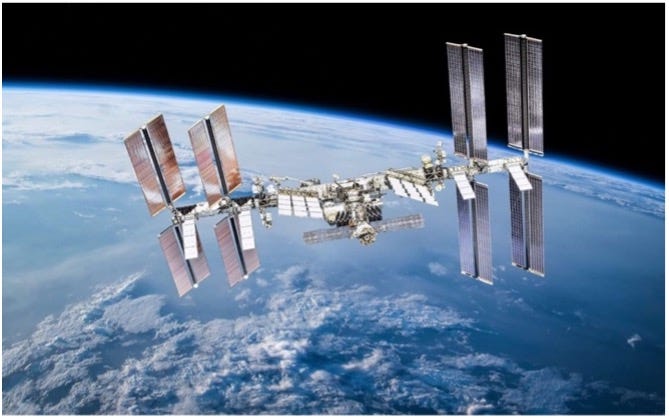
The space station pictured here is 120 feet long and is 350 miles up orbiting around Earth. It travels at a speed of 18,000 miles per hour or 5 miles per second.
Using the Space Station's orbiting speed, it would take us 201,450 years to travel 30